
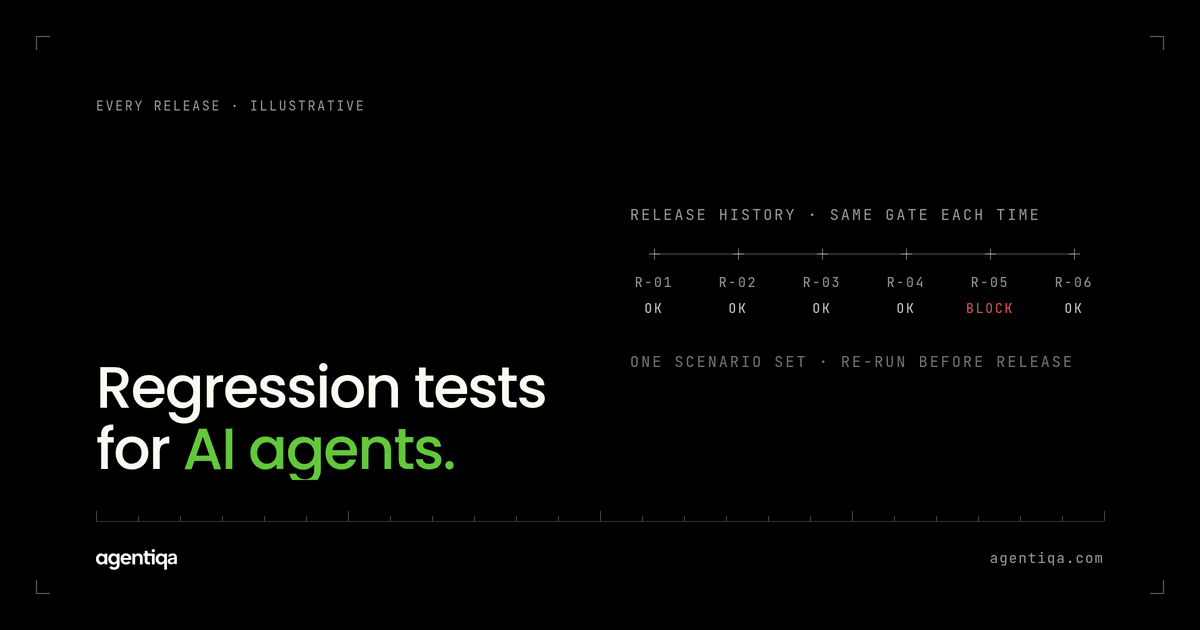
In short: AI agent regression testing means re-running the agent's critical flows on every change to its prompts, model, tools or integration code, plus on a schedule, and checking the end state in the systems it writes to. A failing check blocks the release. The tests assert on outcomes, not exact wording, so normal variation in the agent's behavior doesn't turn a release red.
Why agents regress more often than normal code
In a normal service, behavior changes when someone changes the code. An AI agent can change behavior when any of these change:
- The prompt. A one-line edit can change how the agent reads an error or which tool it picks.
- The model. A provider upgrade, or a switch to a cheaper model, changes reasoning and retry habits.
- The tools. A new parameter, a renamed field or a new wrapper changes what gets written.
- The target systems. The CRM adds a required field, or the ERP changes a validation rule, and nobody on your team touched anything.
Unit tests catch few of these, because they mock the tools and the model's behavior isn't in the code. That's why regression tests for agents have to run the real flows. More on the gap in why all your tests pass but production still breaks. Model changes get their own walkthrough in model update broke your AI agent?
What should trigger a run?
Two triggers cover most of the risk:
- Every release that touches prompts, model configuration, tool definitions or integration code.
- A scheduled run, nightly for example, to catch changes in the target systems and the model provider that happen without a commit on your side.
Treat the result as a release decision: a red result on a critical write flow stops the release until someone has looked at it.
What should the tests assert?
Assert on what ended up in the system, not on what the agent said or which steps it took:
- The end state. The record exists, with exact IDs, amounts, units and status.
- One action, one write. No duplicates, including when a 502 or timeout is injected after the write commits.
- Report matches state. The agent's confirmation quotes values that were actually saved.
- Clean failure is a pass. If the right outcome is "refuse" or "ask a human", check that nothing was written.
The step-by-step method for these checks is in how to test AI agents that write to your CRM or ERP, and the retry cases are covered in duplicate writes and idempotency testing.
How do you keep the gate trustworthy?
A gate that fails randomly gets switched off. Three habits keep it useful:
- Tolerate variation in steps, not in outcomes. An agent may search before creating, or create and then verify. Both are fine if the end state is right.
- Re-run before you trust a single red, but never ignore a repeat. A flow that fails one run in five will fail in production too.
- Sort failures into three bins: a real regression, an intended change the test should learn, and an environment problem such as an expired test credential. Only the first should block a release.
Every failure should come with the trace, the data diff and steps to reproduce it, so someone can confirm it in minutes.
How is this different from evals?
Many teams already run evals with a score threshold. That's useful for answer quality. Regression tests for write flows answer a different question: did this version write the right data? You want both. The difference is laid out in AI agent release gates vs observability and evals. For the testing approach behind it, see what is agentic testing.
FAQ
What is AI agent regression testing?
Re-running an agent's critical flows after every change to its prompts, model, tools or integrations, and checking that the outcomes, especially the data it writes, are still correct.
How often should agent regression tests run?
Before every release that touches the agent, and on a schedule, such as nightly, to catch changes in the model provider or target systems.
How do you deal with non-deterministic agent output?
Assert on end state rather than exact wording or tool-call order, re-run before trusting a single failure, and treat repeated failures as real.
Should a failed agent regression test block the release?
Yes, for the critical write flows. That's what makes it a release gate rather than a report.
Shipping AI agents with write access to ERP, CRM or billing? Agentiqa sets up high-confidence release gates for vertical AI agents in high-liability domains. The gates run before every release, and the first release gates are live within 7 minutes. Book a 20-Minute Mutation Risk Audit.