
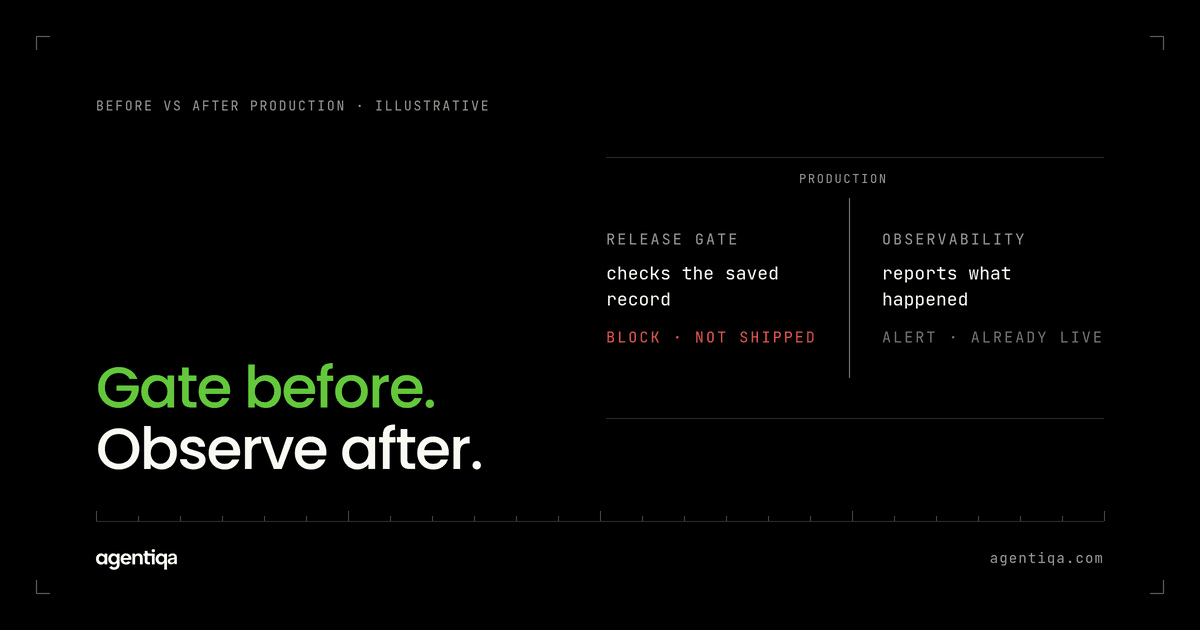
In short: evals score an AI agent's outputs on a dataset, observability records what it did in production, and a release gate runs its critical flows before a release and stops the release if the result is wrong. If your agent writes to ERP, CRM or billing systems, you usually need all three, and the gate is the layer that stops a bad write before a customer sees it.
The categories blur in marketing copy: observability platforms add evals, eval tools add tracing. This post separates them by what each one checks and when it runs.
What is an AI agent release gate?
A release gate is an automated check in your release process. Before a new version ships, it runs the agent's critical flows against a pre-production environment, reads back the records the agent created or changed, and compares them with the expected end state. If a check fails, the release stops, and the failure comes with the trace, the data diff and the steps to reproduce it.
Three properties define it: timing (before production), evidence (real system state, not the transcript) and authority (it can block the release). A longer definition is in what is a quality gate for AI agents?
What evals catch and miss
Evals run the agent on a set of inputs and score the outputs, either with code (valid JSON, required fields) or with an LLM judge. PostHog's guide to testing AI agents notes the judge's weakness: it's non-deterministic too and can grade the same input differently (PostHog).
Good at: answer quality, instruction following, tool choice, comparing prompts and models.
Usually miss: what happened in the real target system. They score the transcript, often with mocked tools, so they don't see that the ERP saved 120 pieces instead of 120 meters, or that a retry created a second order.
What observability catches and misses
Observability platforms capture production traces: prompts, tool calls, latency, cost, errors and feedback. Braintrust describes itself as an observability platform for agents (braintrust.dev), Arize as an agent observability and evaluation platform (arize.com), and Langfuse as open source agent evals and observability (langfuse.com).
Good at: real usage, incident debugging, cost and latency, drift, turning production traces into new eval cases.
Usually misses: anything before production, by definition. It tells you a bad write happened after it happened. And a trace records the call, not whether the record exists with the right values.
Side by side
| Evals | Observability | Release gates | |
|---|---|---|---|
| Question | Is this model/prompt good? | What did the agent do? | May this version ship? |
| When | During development | In production | Before every release |
| Looks at | Outputs and transcripts | Traces and metrics | Saved state in the target systems |
| Tools | Usually mocked | Real, in production | Real integrations in a sandbox, with injected failures |
| Can stop a release? | Only with a score threshold | No | Yes |
Which failures does each catch?
| Failure | Evals | Observability | Release gate |
|---|---|---|---|
| Worse answers after a prompt change | Yes | After users see it | Only if it changes a write |
| Truncated ID or wrong unit in a record | No | Only if someone checks the data | Yes, by reading the record back |
| Duplicate write after a 502 | No, mocks don't fail | After the duplicate exists | Yes, with injected failures |
| Agent says "done", write failed | No, the transcript looks fine | Only with outcome checks | Yes, claim vs record |
| Latency and cost regressions | Partly | Yes | Not its job |
Details on the write failures: duplicate writes and hallucinated success.
Do you need all three?
- The agent only answers or drafts text: evals plus observability cover most of the risk.
- The agent writes to your own internal systems: add targeted write tests for the riskiest actions.
- The agent writes to customer ERP, CRM or billing systems: all three. A bad write lands in someone else's system of record, and the gate is the only layer that prevents it.
A sensible order: observability from day one, evals built from what you see, and release gates on the write flows where a mistake costs the most. How to build the gate is covered in how to test AI agents that write to your CRM or ERP and AI agent regression testing before every release. Where release gates sit among other QA tools is mapped in best AI testing tools. Before the first release, the AI agent production readiness checklist lists what to have in place.
FAQ
What is the difference between AI agent observability and testing?
Observability records what an agent did in production so you can debug and improve it. Testing, including evals and release gates, checks behavior before users are affected. Observability tells you a bad write happened; a release gate stops it from shipping.
Are evals enough to ship an AI agent with write access?
Usually not. Evals score transcripts, typically with mocked tools, so they don't see the records the agent saved or what happens when an API fails.
Do release gates replace Langfuse, Arize or Braintrust?
No. They're complementary. Observability and eval platforms help you understand and improve the agent; release gates decide whether a specific version may ship.
Shipping AI agents with write access to ERP, CRM or billing? Agentiqa sets up high-confidence release gates for vertical AI agents in high-liability domains and works alongside your observability and eval stack. The gates run before every release, and the first release gates are live within 7 minutes. Book a 20-Minute Mutation Risk Audit.
Testing your own web app? Start free with the Agentiqa Community Edition.