
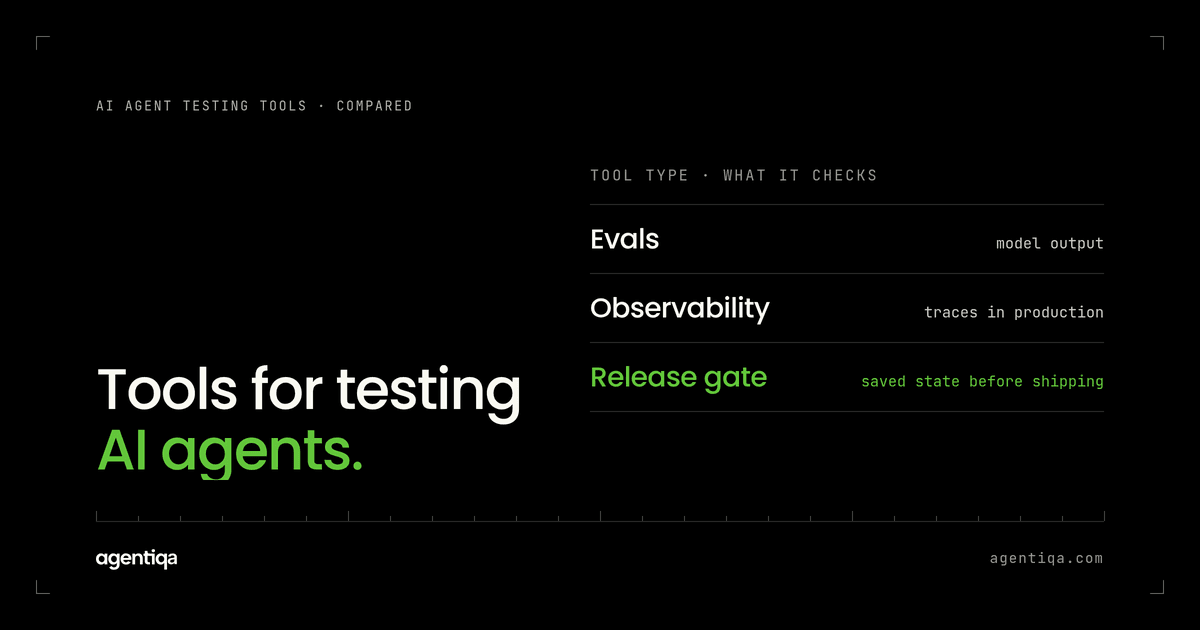
In short: the eight AI agent testing tools compared here fall into two groups. Braintrust, LangSmith, Langfuse, Arize Phoenix, Confident AI (DeepEval) and Comet Opik trace agents and score their outputs and steps. Agentiqa checks what a run actually changed in the systems the agent works in. An agent that writes data needs checks from both groups.
We make Agentiqa, so read this as a vendor's comparison. Every fact about another tool comes from that tool's own pages, linked in the Sources section, checked on 31 October and 1 November 2026. A "—" in a table means we did not find it on their pages, not that the tool lacks it.
Why the choice matters now
LangChain's State of Agent Engineering survey (1,340 respondents, November to December 2025) found that 57% of respondents have agents in production and that quality is the most cited barrier to production (32%). 89% have some observability for their agents, but only 52.4% run offline evaluations on test sets and 37.3% run online evaluations. In that survey, more respondents could see what their agents did than checked a new version on a test set before it shipped.
Benchmarks show why that gap matters for agents that act. In EnterpriseOps-Gym (ServiceNow Research, March 2026), the best of 14 models released in 2025, Claude Opus 4.5, completed 37.4% of 1,150 enterprise tasks graded on the final database state. In UndoBench (October 2026), naive retries after injected faults left duplicate side effects in 65.62% of Gemini 3.8 Flash runs.
How we compared the tools
Five questions, the same for every tool:
- What does it grade? The answer, the trajectory (steps and tool calls), or what changed in the connected system.
- When does it run? During development, before a release, or in production.
- How do you run it? Cloud, self-hosted, local.
- Is there a free plan? And what the vendor lists as its limit.
- What does the first paid plan cost? As listed on the vendor's pricing page.
AI agent testing tools compared
| Tool | What it is | What it grades | How you run it | Free plan | Paid from |
|---|---|---|---|---|---|
| Braintrust | "The active observability platform for agents" | Traces and tool calls; experiments scored with LLMs, code or humans | Cloud; on-prem or hosted on Enterprise | Starter $0: 1 GB, 10k scores, 14-day retention | Pro $249/month |
| LangSmith | LangChain's tracing and evaluation product | Traces; offline evals on datasets; online evals on production traffic | Cloud; self-hostable in your VPC | Developer $0: 1 seat, 5k base traces a month | Plus $39 per seat a month |
| Langfuse | "Open Source Agent Evals & Observability" | Traces; LLM-as-a-judge, heuristic and human evals | Cloud or self-hosted (MIT) | Hobby: 50k units a month, 30 days of data, 2 users | — |
| Arize Phoenix | "Open-source AI observability & evaluation" | OpenTelemetry traces; evals, datasets, experiments | Local or self-hosted (Elastic License 2.0); Arize AX in the cloud | AX Free: 25k spans a month, 15-day retention | AX Pro $50/month |
| Confident AI (DeepEval) | "The AI quality platform built by the creators of DeepEval" | DeepEval metrics such as task completion and hallucination, with LLM-as-a-judge; evaluation of production traces | DeepEval runs locally (Apache 2.0); Confident AI in the cloud or on-prem | $0 plan with 1 GB-month of trace spans | $200/month |
| Comet Opik | "An end-to-end AI observability platform" for agentic systems | Traces of every step; LLM-as-a-judge; test suites with pass/fail assertions | Self-host the full platform (Apache 2.0) or Comet's cloud | Free tier (limits —) | — |
| Agentiqa | "AI Quality System for Production AI Agents" | Whether each key task still works, judged by what changed in the connected system | — | Community: 20 runs a month | Pro $39/month; Enterprise on request |
Which tool answers which question?
| Your question | Tools built for it |
|---|---|
| What did my agent do in production, step by step? | Braintrust, LangSmith, Langfuse, Arize Phoenix, Opik, Confident AI |
| Is this prompt or model better on my dataset? | Braintrust, LangSmith, Langfuse, Phoenix, DeepEval, Opik |
| Did the agent actually create, change or skip the records it reported? | Agentiqa |
| Did this release break a task that worked in the last one? | LangSmith offline evals, Braintrust experiments, Agentiqa release gates |
The tools one by one
Braintrust
What it does. Braintrust calls itself "the active observability platform for agents". It traces agents and tool calls with latency, cost and quality, runs experiments on datasets that compare prompts and models, and scores outputs with LLMs, code or humans. It finds recurring issues in production traces and turns real failures into regression tests. SDKs cover Python, TypeScript, Go, Ruby and C#.
Good fit when your team wants one place for traces, datasets and scored experiments, and grades mostly on outputs and steps.
Pricing. Starter is $0 with 1 GB of data, 10k scores and 14-day retention. Pro is $249 a month. Enterprise is custom.
LangSmith
What it does. LangSmith, from LangChain, traces agents with SDKs for Python, TypeScript, Go and Java and supports OpenTelemetry. It runs offline evals on curated datasets "to catch regressions before deployment" and online evals on production traffic, with LLM-as-judge and code evaluators.
Good fit when you build on LangChain or LangGraph, or want offline and online evals in one product.
Pricing. Developer is $0 for one seat and 5k base traces a month. Plus is $39 per seat a month with 10k base traces.
Langfuse
What it does. Langfuse describes itself as "Open Source Agent Evals & Observability". It traces LLM calls, tool invocations and retrieval, and evaluates with LLM-as-a-judge, heuristic functions and human review. It also covers prompt management, datasets, experiments and annotation queues.
Good fit when you want to self-host under an MIT license and keep traces in your own infrastructure.
Pricing. Hobby needs no credit card and includes 50k units a month, 30 days of data and 2 users.
Arize Phoenix
What it does. Phoenix is Arize's "open-source AI observability & evaluation" tool: OpenTelemetry tracing, evals, versioned datasets, experiments, a playground and prompt management. It runs locally or self-hosted under the Elastic License 2.0. Arize AX is the hosted product.
Good fit when you want open-source tracing and evals you can run on a laptop, with a hosted option later.
Pricing. AX Free is $0 with 25k spans a month and 15-day retention. AX Pro is $50 a month.
Confident AI and DeepEval
What it does. DeepEval is an open-source evaluation framework under Apache 2.0, "similar to Pytest but specialized for unit testing LLM apps", with metrics such as task completion, answer relevancy and hallucination. Confident AI is the cloud platform from the same team. It adds datasets, tracing, monitoring and dashboards, and evaluates production traces to group failures into issues. It is SOC 2 Type II compliant and offers cloud and on-prem deployment.
Good fit when your team wants evals written next to its tests, with a hosted dashboard on top.
Pricing. A $0 plan includes 1 GB-month of trace spans. Paid plans start at $200 a month.
Comet Opik
What it does. Opik logs every step an agent takes, from user input to retrieval and tool calls, with automated evals across development, testing and production. It supports test suites with global rules and item-level assertions that give pass/fail results. The full platform is Apache 2.0 and can be self-hosted.
Good fit when you want an open-source platform with tracing, LLM-as-a-judge and pass/fail test suites in one place.
Pricing. Comet lists a free tier and an enterprise plan; we did not find plan limits on the pages we checked.
Agentiqa
What it does. Agentiqa is an AI Quality System for production AI agents. Release gates run the agent's key tasks before each release. Each task is described in plain words and run in a real browser with a test account, and each check is graded. The gate looks at what changed in the connected system, not only at the agent's reply. When you rerun the failed tasks, AI Quality Manager reports a step as a regression only if it fails again. Unconfirmed failures are listed separately. Each failure comes with a trace, the recording and steps to reproduce.
AI Quality Manager compares each release with the previous one, shows regression candidates and proposes test updates and new tests. A person on your team approves them.
Good fit when your agent creates or changes records in ERP, CRM, billing or practice management systems, especially in procurement, legal, finance and supply chain. First release gates are live within 7 minutes. For enterprise teams, an Agentiqa engineer sets up the gates on the riskiest tasks over a 3-day rollout and keeps them current.
Where it is not the right tool. Agentiqa is not designed for agents that only answer questions or generate text, and its gates run before a release, not in production. For production traces, pair it with one of the observability tools above.
Pricing. Community is free with 20 runs a month. Pro is $39 a month. Enterprise is priced on request.
How the tools fit together
For an agent that writes data, the tools fit into three layers:
- Evals during development, to compare prompts and models on a dataset (Braintrust, LangSmith, Langfuse, Phoenix, DeepEval, Opik).
- Checks before each release on what the agent changed in a test copy of the real systems (Agentiqa).
- Observability in production, to see what happened after release (any of the tracing tools above).
Side-by-side pages for single tools are in Agentiqa compared, including Agentiqa vs Braintrust and Agentiqa vs LangSmith. The trade-offs between these layers are covered in release gates vs observability and evals. What a release gate checks is in what is an AI agent release gate, and the failures these tools are trying to find are in AI agent failure modes when agents can write and, with benchmark data, in what errors AI agents make. A step-by-step method is in how to test an AI agent before production, and example gates for procurement, legal, finance and supply chain agents are in release gates for AI agents: examples by domain.
FAQ
What are the best AI agent testing tools in 2026?
It depends on what you need graded. For traces and output evals: Braintrust, LangSmith, Langfuse, Arize Phoenix, Confident AI (DeepEval) and Comet Opik. For checking what an agent actually changed in connected systems: Agentiqa.
What is the difference between agent evaluation and agent testing?
Evaluation usually scores outputs or steps on a dataset with metrics or LLM judges. Testing an agent that acts also checks the result in the systems it touched: the record exists, the amounts and IDs are right, and nothing was written twice.
Which AI agent testing tools are open source?
On their own pages, Langfuse lists MIT self-hosting, Arize describes Phoenix as open source under the Elastic License 2.0, and DeepEval and Comet Opik are Apache 2.0.
Can I use an observability tool as a release check?
Partly. LangSmith offline evals and Braintrust experiments can compare versions on a dataset before deployment. They grade outputs and steps. If the risk is a wrong or duplicate write, add checks that read the saved records back.
Do I need a separate tool for agents that write to ERP or CRM?
You need checks on the saved state, whatever tool runs them. The method is in how to test AI agents that write to your CRM or ERP.
Sources
- Braintrust, homepage and pricing, checked 31 October 2026.
- LangChain, LangSmith observability, LangSmith evaluation and pricing, checked 31 October 2026.
- Langfuse, homepage, pricing and Langfuse vs LangSmith, checked 31 October 2026.
- Arize, Phoenix, Phoenix on GitHub and pricing, checked 31 October 2026.
- Confident AI, homepage, pricing and DeepEval on GitHub, checked 1 November 2026.
- Comet, Opik and Opik on GitHub, checked 1 November 2026.
- Agentiqa, homepage, pricing and Enterprise.
- LangChain, State of Agent Engineering. Survey of 1,340 respondents, 18 November to 2 December 2025.
- ServiceNow Research, "EnterpriseOps-Gym", March 2026. arXiv:2603.13594.
- Sah et al., "UndoBench", October 2026. arXiv:2610.05622.
Testing an agent that writes data? Start free with the Agentiqa Community Edition: 20 runs a month. Plans are on the pricing page.