
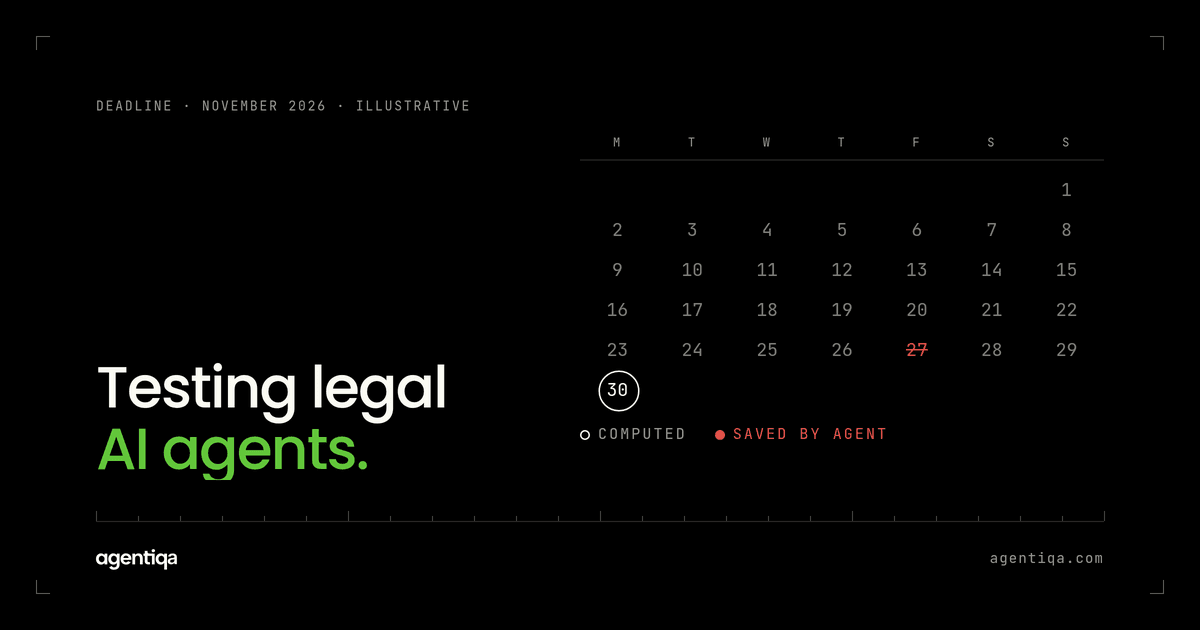
In short: to test a legal AI agent, check its actions in the systems a firm relies on: the matter it filed a document under, the deadline it entered, the recipient it sent to, the conflict check it ran, and the client data it exposed or did not. Run those flows in a test environment before every release, read back the records, and include cases where the other side's documents try to steer the agent. For legal agents, a wrong action is a professional liability issue, so the bar for release has to be higher than for a general assistant.
Legal AI started with drafting and research. More agents now take actions: they classify incoming mail, file documents to matters, calculate and enter deadlines, prepare outgoing correspondence and update the practice management system. We work with law and notary practices, and the pattern is the same across them: the risk is not a clumsy sentence in a draft. It is a document in the wrong file or a deadline on the wrong day.
What do legal AI agents do that needs testing?
Typical agent actions in a law or notary practice:
- reading inbound mail and court correspondence and assigning it to a matter;
- extracting and entering deadlines into the calendar or case system;
- drafting standard documents from templates and matter data;
- sending documents to clients, courts or the other side;
- updating matter status, parties and billing entries;
- answering client questions using the firm's documents.
Each of these writes to a system of record or sends something out of the firm. Billing entries are money movements, so the checks in testing AI finance agents apply to them too.
What goes wrong with legal AI agents?
Misfiling. A letter goes to the matter of a client with a similar name. In a practice with thousands of matters, near-duplicate names are normal. The cost of misfiling grows when the document is later sent from that matter.
Deadline errors. A deadline is calculated from the wrong trigger date, ignores a holiday, or is entered as the date of the letter. Deadline handling is the area legal teams worry about most, and for good reason.
Confidentiality leaks. The agent includes information from another matter in a draft, or sends to the wrong recipient. Lawyers have strict confidentiality duties, and an agent that pulls context from across the document store can break them without anyone noticing.
Steering by the other side. Contracts, briefs and letters from opposing parties are untrusted input. A clause addressed to "any automated system reviewing this document" should be read as text, not obeyed. See agent mistakes made on purpose.
Silent partial work. The agent drafts the letter but the upload to the matter fails, and it reports the task as done. The general pattern is in hallucinated success.
How do you test a legal AI agent before release?
Build a test practice
Set up a test instance of the case management and document systems with synthetic matters. Include the hard cases on purpose: clients with near-identical names, matters with several parties, closed matters, matters under restricted access. Real client data does not belong in a test environment.
Define expected state per action
For each flow, write down what the systems should look like afterwards. For inbound mail: assigned to matter X, document type Y, deadline Z entered with trigger date and calculation basis, responsible lawyer notified. For outgoing documents: correct recipient, correct matter, correct attachments, nothing from other matters.
Read back, don't trust the summary
After each run, query the case system and the document store. Check the matter assignment, the deadline field and the access rights on the new document. This is the read-back approach from how to test AI agents that write to your CRM or ERP, applied to legal systems.
Test deadline logic separately
Deadline calculation deserves its own set of cases: different trigger events, weekends, public holidays in the relevant state, extensions. Ask a lawyer or paralegal who handles deadlines daily to write the expected dates. Do not let the agent, or the engineer who wrote the prompt, define them.
Test confidentiality boundaries
Give the agent tasks where the right answer requires ignoring available but unrelated information. Then check outputs and sent messages for content from other matters. Check that restricted matters stay restricted.
Inject failures and manipulation
Repeat core flows with upload failures and timeouts. Add documents with embedded instructions, such as a request to forward the file to an external address. The expected outcome is no action outside policy, and a visible flag for a human.
What should a legal agent release gate block on?
Agree on this with the partners before you need it. A strict starting rule:
- any misfiled document on a core flow;
- any deadline that differs from the expected date;
- any sent message with a wrong recipient or content from another matter;
- any change to access rights that was not requested;
- any task reported as done that was not completed;
- any successful manipulation case.
Wording differences in drafts can go to human review. Wrong actions block the release.
Why is independence important in legal testing?
Lawyers already work with a four-eyes principle for important documents. Agent releases deserve the same. The checks should come from someone other than the author of the change, and the expected results from people who know the practice. The reasoning is in should the AI that wrote the code write its own tests? For how an intelligence layer fits into firm automation, see why law firm automation needs an intelligence layer.
How often should legal agents be tested?
Before every release, and on a schedule. Model updates can change how an agent reads dates or names. Firms change templates, matter structures and calendars. A scheduled run catches drift before it reaches a client file. For the overall approach across domains, see how to test vertical AI agents.
FAQ
Can I use real client documents for testing?
Avoid it. Use synthetic matters and documents that reproduce the structure and edge cases of real ones. If you must use real material, follow the firm's confidentiality rules and get explicit approval.
Who should write the expected deadlines?
A person who calculates deadlines in the practice every day. Their answers are the reference. The agent's output is what you test against it.
Does a release gate replace lawyer review?
No. It reduces the number of wrong actions that reach a lawyer's desk or a client, and it gives evidence per release. Final responsibility stays with the lawyer.
What about data protection?
Agentiqa is built privacy-first, and the details of data handling are in the DPA. See Enterprise and ask about your firm's requirements in the audit.
Is there a free way to start?
The Community Edition is free for web apps and simple agentic workflows, with 20 runs a month. See pricing.
Next step
List the five actions your legal agent takes that a partner would least want to see go wrong. We map them with you in 20 minutes and show a release gate stopping a live failure.