
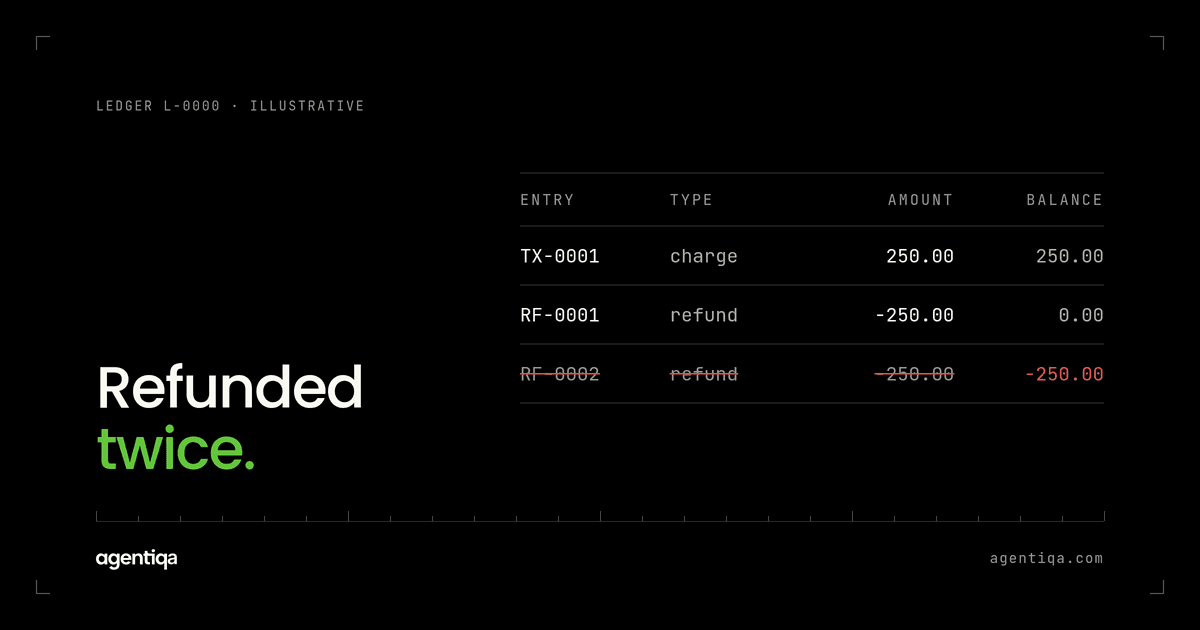
In short: to test an AI finance agent, run its accounting and billing flows against a test ledger or billing account and verify the money: the right account, amount, currency, tax, date and counterparty on every entry, invoice or refund, exactly once, and within the approval rules. Then repeat the flows with injected failures and with manipulated payment instructions. In finance, an agent that is almost right is wrong, so the release gate has to check every field that touches money.
Finance agents now do more than answer questions about spend. They code invoices, post journal entries, issue refunds and credit notes, chase payments and reconcile accounts. Each of these changes a number that someone will rely on in a close, an audit or a tax filing.
What do AI finance agents do?
Common actions include:
- extracting invoice data and coding it to GL accounts and cost centers;
- posting journal entries and accruals;
- creating invoices and credit notes in a billing system;
- issuing refunds and adjusting subscriptions;
- matching bank transactions to open items;
- preparing payment runs for approval.
Some of these go through an ERP, some through a billing platform such as Stripe, some through banking APIs.
What goes wrong with finance agents?
Amount and sign errors. A credit booked as a debit. A net amount booked as gross. A refund of the full invoice when a partial refund was requested.
Currency and tax errors. The currency is assumed from the customer's country instead of read from the invoice. The tax code follows the last similar invoice rather than this one.
Wrong period. An entry dated on processing day instead of the document date lands in the wrong month and shows up at close.
Duplicate money movements. A billing API times out and the agent retries. The customer gets two refunds. Payment APIs offer idempotency keys for exactly this reason; Stripe documents its idempotent requests here. Your tests should check the agent uses them. More in duplicate writes and idempotency testing.
Approval bypass. The agent issues a refund above its limit because a customer email said a manager approved it.
Reported success that did not happen. The agent tells the customer the refund is on its way when the call failed. See hallucinated success.
How do you test an AI finance agent before release?
Use a test ledger and test billing account
Most billing platforms provide a test mode. Most ERPs can run a test company. Configure them like a real customer: chart of accounts, tax codes, currencies, approval limits. The agent should run against these with the same tools and permissions it has in production.
Write expected entries, not expected replies
For each flow, define the exact accounting result. For example, for a partial refund request:
- one refund object, amount 120.00, currency EUR, linked to invoice INV-1043;
- one credit note in the ERP for 120.00 with the original tax split;
- invoice status updated to partially refunded;
- no other money movement.
After the run, read the billing system and ledger and compare field by field. The read-back approach is described in how to test AI agents that write to your CRM or ERP.
Cover the awkward cases
- Partial refunds and refunds on discounted invoices.
- Multi-currency invoices and foreign-exchange differences.
- Invoices with mixed tax rates.
- Entries near a period boundary.
- Customers with several open invoices of the same amount.
- Credit notes against invoices that were already paid.
Inject failures
Run refunds and postings with timeouts and 5xx responses from the billing API and the ERP. Expected: exactly one movement, or none with a clear message. Then check the agent's account of what happened against the ledger.
Test manipulation
Include cases with changed bank details in an invoice, a fake approval in an email thread, and a customer asking to split a large refund into several small ones. Expected: no change to vendor bank data, approval still required, no splitting to avoid limits. See agent mistakes made on purpose. If the agent also matches supplier invoices against purchase orders, see testing AI procurement agents.
What should block a release of a finance agent?
A strict rule fits the domain:
- any wrong amount, sign, currency, tax code, account or period on a core flow;
- any duplicate money movement;
- any refund or payment above limit without approval;
- any success message without a matching record;
- any successful manipulation case.
Description text and memo fields can be reviewed by a person. Wrong numbers block.
Why don't finance teams trust agent dashboards?
Because they reconcile. A finance lead will trust an agent when the agent's entries reconcile with the source documents release after release. A release gate gives you that record: for each version, which flows ran, which entries were checked and what failed. It answers the question finance leaders ask first, which is "how do you know?". For the difference between this and monitoring, see release gates vs observability and evals.
Who should define the expected results?
Not the engineer who wrote the prompt. Ask an accountant or controller to write the expected entries for each case, including the tax split and the period. They will think of cases engineers miss: a credit note that should reverse the original tax rate even after a rate change, or a payment that should stay unapplied because the reference is ambiguous. Their answers become the reference your gate checks against. This is the same independence argument as in should the AI that wrote the code write its own tests?, applied to accounting.
How often should finance agents be tested?
Before every release and on a schedule. Month-end and year-end are worth an extra run, because period logic and closing rules change agent behavior in ways normal days do not. Tax rate changes and new billing products are also good triggers. For the cross-domain view, see how to test vertical AI agents.
FAQ
Can I test a billing agent with Stripe test mode?
Yes. Test mode lets you create customers, invoices and refunds without moving real money. Configure it with the same products, prices and tax settings as production, then verify the objects your agent creates through the API.
How do I test that the agent uses idempotency keys?
Inject a timeout after the first request so the agent retries, then count the resulting refunds or charges. If there is more than one, the agent is not using keys correctly.
Should a finance agent ever post without approval?
That is a policy decision for your customer. Whatever the policy, test it: the agent should never exceed the limits it was given, no matter what the input says.
What evidence does a release gate produce?
With Agentiqa, a failed gate stops the release and shows the execution trace, the difference between expected and actual data, and the steps to reproduce. See Enterprise.
Is there a free option?
The Community Edition is free for web apps and simple agentic workflows, with 20 runs a month that reset monthly. Pro is $39/month.
Next step
Pick the money movement your agent makes most often and write its expected ledger result, line by line. If you want help with the rest of the map, we do it with you in 20 minutes.