
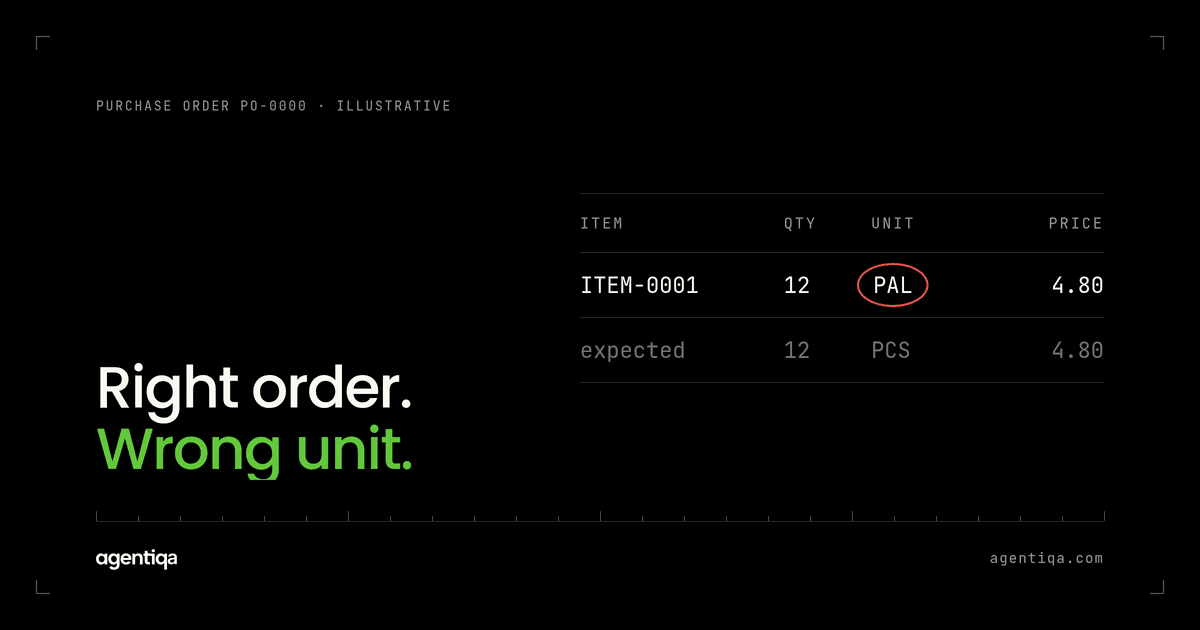
In short: to test an AI procurement agent, run its real purchasing flows in a test instance of the procurement system and check what it wrote: the right supplier, cost center, quantities, units, prices and approval path on each requisition or purchase order, exactly once. Then repeat the flows with injected failures and with manipulated supplier documents. A procurement agent is judged by the state of the purchasing system after it runs, not by its chat replies.
Procurement is one of the first domains where AI agents moved from suggesting to acting. Agents now draft requisitions, pick suppliers from a catalog, create purchase orders and match invoices. Each of those is a write into a system that the finance team relies on. This post covers what to test and how.
What does an AI procurement agent actually do?
The common jobs are:
- turning a free-text request ("we need 40 laptops for the new Munich team") into a requisition;
- choosing a supplier and catalog item, or creating a non-catalog line;
- assigning cost center, GL account and delivery address;
- routing for approval based on amount and category;
- creating and sending the purchase order;
- matching incoming invoices against POs and goods receipts.
Every step is a write or a decision that leads to one. The agent is usually connected to a procurement suite or ERP through APIs, and often to email for supplier communication.
What goes wrong with procurement agents?
The failures we see most fall into a few groups.
Wrong field, plausible value. The cost center of the requester's previous team. The right supplier but the wrong site. A delivery address from an old order. These look fine in a transcript and pass basic validation.
Unit and quantity errors. A request for 40 boxes becomes 40 pieces. A price per unit is booked as a line total. Currency is assumed rather than read. We describe the general pattern in AI agent wrote wrong data to your CRM or ERP.
Approval path skipped or bent. The agent splits an order below a threshold, picks a category with lighter approval, or treats an email that says "approved" as an approval.
Duplicates under retries. The procurement API times out, the agent retries, and two POs go to the supplier. See duplicate writes and idempotency testing.
Reported success that did not happen. The agent tells the requester the order is placed when the submit call failed. See hallucinated success.
How do you test an AI procurement agent?
Set up a realistic test tenant
Use a test instance of the procurement system with real configuration: the same approval rules, categories, cost centers and required fields as a customer's production tenant, with synthetic suppliers and catalog data. A mock that accepts any payload will not show you validation errors or approval routing.
Write flows with expected end state
For each core flow, write the request and the expected state after the run. For example:
- Request: "Order 40 of the standard developer laptop for cost center 4100, deliver to the Munich office."
- Expected: one requisition, one line, catalog item ID matches, quantity 40, unit "piece", cost center 4100, delivery address Munich, routed to the approver for that amount band, status "pending approval".
Then check every one of those fields after the run by reading the procurement system's API, not the agent's message.
Cover the variants that matter
- Non-catalog items, where the agent has to create a free-text line.
- Requests that cross approval thresholds.
- Requests with ambiguous units ("a box of cables").
- Multi-currency suppliers.
- Changes and cancellations of existing POs.
- Invoice matching with a price or quantity mismatch.
Inject failures
Repeat the core flows with a timeout on submit, a 502 from the supplier lookup, and a slow approval service. The expected result is either one correct PO or a clean failure the requester is told about. Never two POs, and never a "done" message without a PO.
Test deliberate manipulation
Supplier documents and emails are untrusted input. Include cases such as an invoice with hidden text asking to change bank details, or an email claiming approval. The expected outcome is no change to supplier master data and no skipped approval. Our guide to misuse and prompt injection testing lists more patterns.
When should procurement agent tests run?
Before every release of the agent, and on a schedule. Releases cover prompt, tool and model changes on your side. A schedule covers changes on the customer side: new required fields, new approval rules, a supplier catalog update. The case study with an AI procurement company describes nightly agentic regression runs against agents that write into enterprise procurement systems, with each failure reported with the evidence needed to fix it.
What should block a release?
Decide this in advance, or every red result becomes a debate. A reasonable starting rule:
- any wrong supplier, cost center, quantity, unit, price or currency on a core flow;
- any duplicate PO;
- any skipped or altered approval;
- any success message without a matching record;
- any successful manipulation case.
Formatting differences in a PO description or a slower run do not block. Wrong data does.
How does this fit with evals and monitoring?
Evals help you tune how the agent understands requests. Monitoring shows what it does in a customer's production tenant. The release gate sits between them and answers one question: does this version still create correct purchasing records? The three are compared in release gates vs observability and evals. For a broader view of the category, see how to test vertical AI agents.
Which test data should you use?
Synthetic, but shaped like production. Copy the structure of a real customer tenant: the number of cost centers, the approval bands, the mix of catalog and non-catalog spend, the currencies. Then fill it with invented suppliers and items. Keep a few deliberately awkward records: two suppliers with similar names, an item sold by the box and by the piece, a cost center that was closed last quarter. Those records are where agents pick the plausible but wrong value, and they make your tests far more useful than a clean demo dataset.
FAQ
Can I test a procurement agent against a mock API?
For unit tests, yes. For release decisions, no. Mocks hide validation rules, approval routing and real error shapes, which is where procurement agents fail. Use a configured test tenant.
How do I test invoice matching?
Create POs and goods receipts in the test tenant, then feed invoices with exact matches, price variances, quantity variances and unknown PO numbers. Check the match status and any exceptions the agent raised in the system. The accounting side of the same invoices is covered in testing AI finance agents.
What about supplier emails?
Treat them as untrusted input. Test that instructions inside them, such as bank changes or approval claims, do not change master data or skip workflow steps.
Does Agentiqa integrate with my procurement suite?
Agentiqa tests your agent's flows and checks what was written. The setup depends on how your agent connects to the target system. We scope it in the audit; see Enterprise.
Is there a free tier?
Yes. The Community Edition is free for web apps and simple agentic workflows, with 20 runs a month that reset monthly. Pro is $39/month.
Next step
Write down the expected end state of your three most common purchasing flows, field by field. If you would like a second pair of eyes on that list, we map it with you in 20 minutes and show a release gate stopping a live failure.