
In short: to test a supply chain AI agent, run its ordering, scheduling and inventory flows against a test instance of the ERP or warehouse system and check the resulting state: the right item, quantity, unit, location, supplier and date on each order or stock movement, exactly once. Repeat with upstream failures, late confirmations and manipulated supplier messages. Supply chain mistakes multiply, because one wrong replenishment order drives the next forecast, so the release gate should focus on the writes that feed other processes.
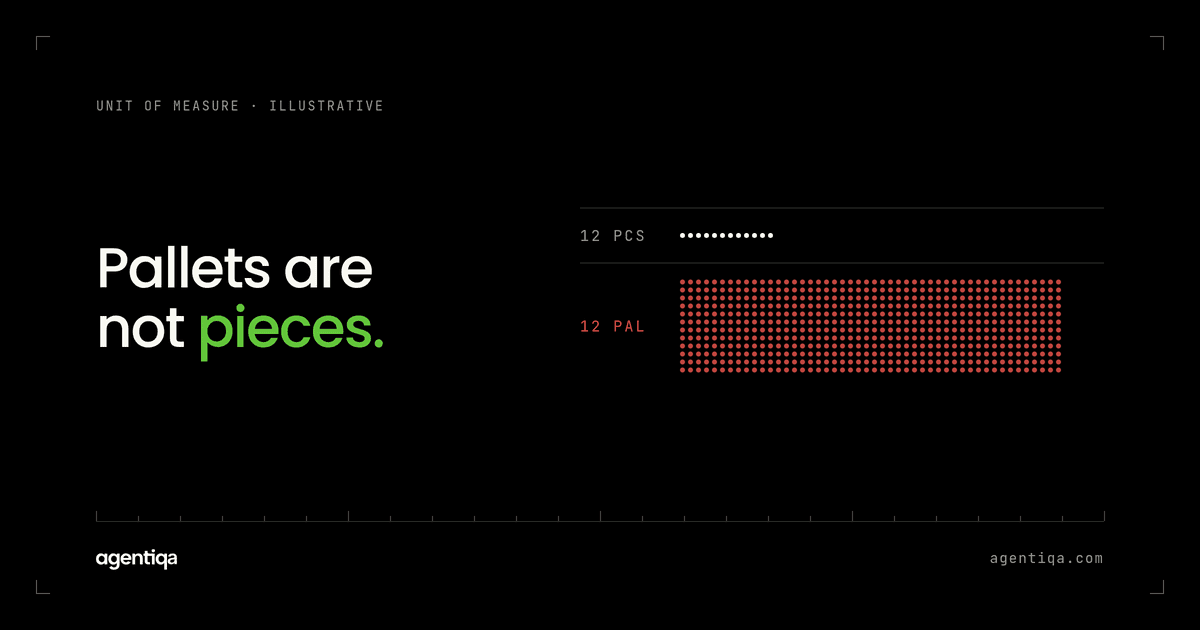
Supply chain agents place replenishment orders, confirm or reschedule deliveries, update stock after receipts and talk to suppliers and carriers. They work in systems where a single field, such as a unit of measure, decides whether a warehouse receives ten pallets or ten pieces.
What do supply chain AI agents do?
Typical actions:
- creating replenishment or purchase orders from demand signals;
- confirming, changing or cancelling delivery dates;
- booking goods receipts and stock transfers;
- updating safety stock or reorder points;
- reading supplier confirmations and carrier updates;
- raising exceptions when a shipment is late or short.
Most of these write into an ERP or warehouse management system. Some send messages to suppliers.
What goes wrong with supply chain agents?
Unit of measure errors. The classic. An item is sold by the box of 12 and stocked by the piece. The agent orders 50 when it meant 50 boxes, or the other way round. A line booked in pieces when it should be meters is the same failure in a different material.
Wrong location or plant. The agent replenishes the main warehouse when the demand is at a regional site.
Date errors. A requested delivery date entered as a ship date, or a time zone shift that moves a confirmation to the wrong day.
Duplicate orders. A slow ERP response leads to a retry and two orders for the same need. More in duplicate writes and idempotency testing.
Changes to master data. The agent updates a reorder point or lead time based on one unusual week. That change quietly affects every future order.
Acting on manipulated messages. A supplier email asks to change the delivery address or confirms a price increase that was never agreed. See agent mistakes made on purpose.
How do you test a supply chain AI agent before release?
Model a realistic network
Set up a test ERP or WMS instance with a few plants or warehouses, items with different units of measure, suppliers with different lead times, and open orders in various states. Include the awkward data on purpose: items with conversion factors, a supplier with two delivery addresses, a blocked item.
Define the expected state per flow
For a replenishment flow, write the expected order: item, quantity, unit, plant, supplier, requested date, price source. For a goods receipt, the expected stock change per location and the status of the order line. For a reschedule, the new date and the messages that should and should not go out.
Read back and compare
After the run, read the order, stock and master data tables through the system's API and compare with the expected state. Pay special attention to unit and quantity together. The read-back method is covered in how to test AI agents that write to your CRM or ERP, and the failure pattern in AI agent wrote wrong data to your CRM or ERP.
Check side effects
Supply chain writes trigger other processes. A new order may create a planned receipt, change available-to-promise and send an EDI message. Check that the expected side effects happened and that nothing else did. In particular, check that master data such as reorder points did not change unless the flow was meant to change them.
Inject failures
Repeat flows with a slow ERP, a rejected order because of a blocked item, and a missing supplier confirmation. Expected: one correct order or a clean exception, never two orders, never a silent failure. If the agent reports a booking that never happened, that is hallucinated success.
What should block a release of a supply chain agent?
- any wrong item, quantity, unit, location, supplier or date on a core flow;
- any duplicate order or stock movement;
- any unrequested change to master data;
- any supplier message that should not have gone out;
- any success message without a matching record;
- any successful manipulation case.
What does a good failure report look like?
When a supply chain flow fails, the person fixing it needs more than "test failed". A useful report shows the request, each tool call the agent made with its inputs and outputs, the expected and actual state of the order and stock tables side by side, and the steps to reproduce. With that, a planner can tell in a minute whether the agent misread the unit, picked the wrong plant or hit a system error, and an engineer knows where to look.
How is supply chain testing different from procurement testing?
They overlap, and many agents do both. Procurement testing focuses on who may buy what, from whom, under which approval. Supply chain testing focuses on physical flow: quantities, units, locations, dates and their effect on planning. If your agent creates purchase orders from demand signals, test both sides. The procurement view is in how to test AI procurement agents, and the general approach in how to test vertical AI agents.
How often should supply chain agents be tested?
Before every release, and on a schedule that follows the business rhythm. Planning runs, seasonal peaks and new item introductions are good triggers. A scheduled run also catches changes on the customer side, such as a new plant or a changed unit of measure, before the agent writes against them in production.
Who should write the expected results?
A planner or buyer who works in the system every day. They know which unit a supplier really ships in, which plant gets which material, and which lead times are fiction. Their expected results are the reference. The engineer owns the gate, and an independent tool or team runs it.
FAQ
Why are unit of measure errors so common with agents?
Because the information is spread across item master data, supplier conditions and the request text, and the agent has to combine them. A model can read "50" correctly and still apply the wrong unit. Test every flow with items that have conversion factors.
Should the agent be allowed to change master data?
Only if that is an explicit, tested flow with approval. Otherwise, test that it does not, because master data changes affect every future order.
Can I test against a sandbox instead of a full ERP?
For release decisions, use something that enforces the same validation and units as production. A permissive sandbox hides the failures that matter.
What does Agentiqa provide?
Release gates for vertical AI agents in high-liability domains. Gates run the agent's critical flows, check the written data, and stop the release on failure with the trace and data diff. First release gates live within 7 minutes. See Enterprise.
Is there a free tier?
The Community Edition is free for web apps and simple agentic workflows, with 20 runs a month. See pricing.
Next step
Find the three items in your test data with unit conversions and run your agent's replenishment flow on them. If the results surprise you, we can map the rest with you in 20 minutes.