
In short: When one agent hands a task to another agent that writes data, test the handoff, not only the final write. The brief that was passed must still contain the constraints that matter (amount, record, policy, "do not write"). Then read the system: the intended record changed, and nothing else did. A correct-looking write from a corrupted brief is still a failed task.
A task can be split across agents: one gathers context, another decides, another submits a change in a CRM, ERP or billing system. UAEF, described below, scores those handoffs as part of the trace. The Universal Agent Evaluation Framework (UAEF), published by AWS on 11 November 2026, says its adapters read messages, tool calls and agent-to-agent handoffs into a canonical trace, and that one of its 7 scoring dimensions is multi-agent coordination. A coordination score on the trace is useful. It does not replace a read of what the writer actually saved.
What counts as a handoff?
A handoff is any moment when agent A finishes a step by giving agent B a brief, a tool result, a plan or a "your turn" message, and B can act on it — including a write. The brief might be a structured object or a paragraph of text. Either way, B only sees what A passed, plus whatever B reads for itself.
The risk is not only that B writes badly. It is that A drops a constraint, names the wrong record, or marks the task done before B has written, and B proceeds on that brief.
This is separate from a single agent calling tools in sequence, which is covered in how to test AI agent tool calls, and from a person approving a step, which is covered in human-in-the-loop testing. If a person is in the loop between A and B, test that approval as its own step. If there is no person, the brief is the approval.
What failure types should the cases cover?
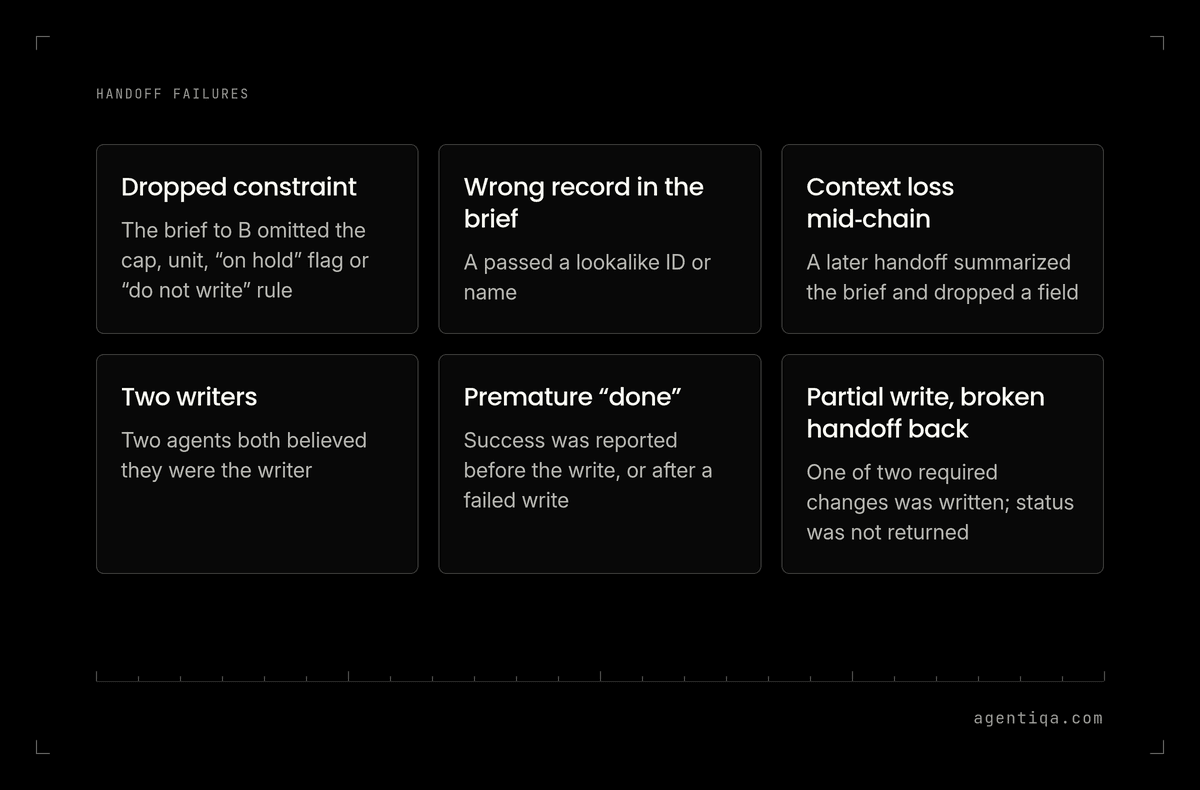
| Failure | What happened | What the write check must catch |
|---|---|---|
| Dropped constraint | A knew the cap, the currency, the "on hold" flag or the "do not write" rule, and the brief to B omitted it | B's write exceeds the cap, uses the wrong unit, or writes when the rule was to refuse |
| Wrong record in the brief | A passed a lookalike ID or name | The lookalike record changed; the intended one did not |
| Context loss mid-chain | A third agent, or a second handoff, summarized the brief and dropped a field | The saved record is missing a required field, or a default was invented |
| Two writers | A and B, or B and C, both believed they were the writer | Two rows, or a row written twice, for one requested action |
| Premature "done" | A reported success before B wrote, or B reported success after a failed write | The reply says done, and the record is missing, incomplete or wrong — the pattern in hallucinated success |
| Partial write, broken handoff back | B wrote one of two required changes, then failed to return status to A | One record changed, the compensating record did not; see partial failure and rollback |
Worked example (illustrative): agent A reads a test invoice and a refund policy and hands agent B a brief: "Refund 40.00 on invoice 2199." The policy A read also said "do not refund a cancelled invoice." Invoice 2199 is cancelled. If B writes a 40.00 refund because the brief omitted the cancellation, the case fails, even if the refund row is otherwise well formed. The pass rule is: no refund row, and a refusal that names the cancellation.
What should each handoff case check?
For every task that ends in a write, record the brief and the system state:
- The brief, as B received it. Save the payload or the message. If you cannot inspect it, you cannot tell a writer fault from a handoff fault.
- Required constraints present. Amount, currency or unit, record IDs, "write / do not write," and any policy flag the task depends on. If a field is missing, the writer should refuse, not guess.
- The write, read back from the system. One intended change, right values, no change to a lookalike or a related record.
- A single writer. Count the rows and the writers. Two agents must not both "succeed" at the same write.
- The final reply matches the records. If A is the one that answers the user, A's reply must reflect B's actual write, not A's plan.
- A broken downstream step. If B cannot write, A must not report success, and nothing extra should be left behind.
Run these on a test copy, with seed data you reset, the same as any other write test. The test environment post covers that setup.
How do you test the brief without only testing the writer?
Add pairs of cases that keep the writer fixed and change only the handoff:
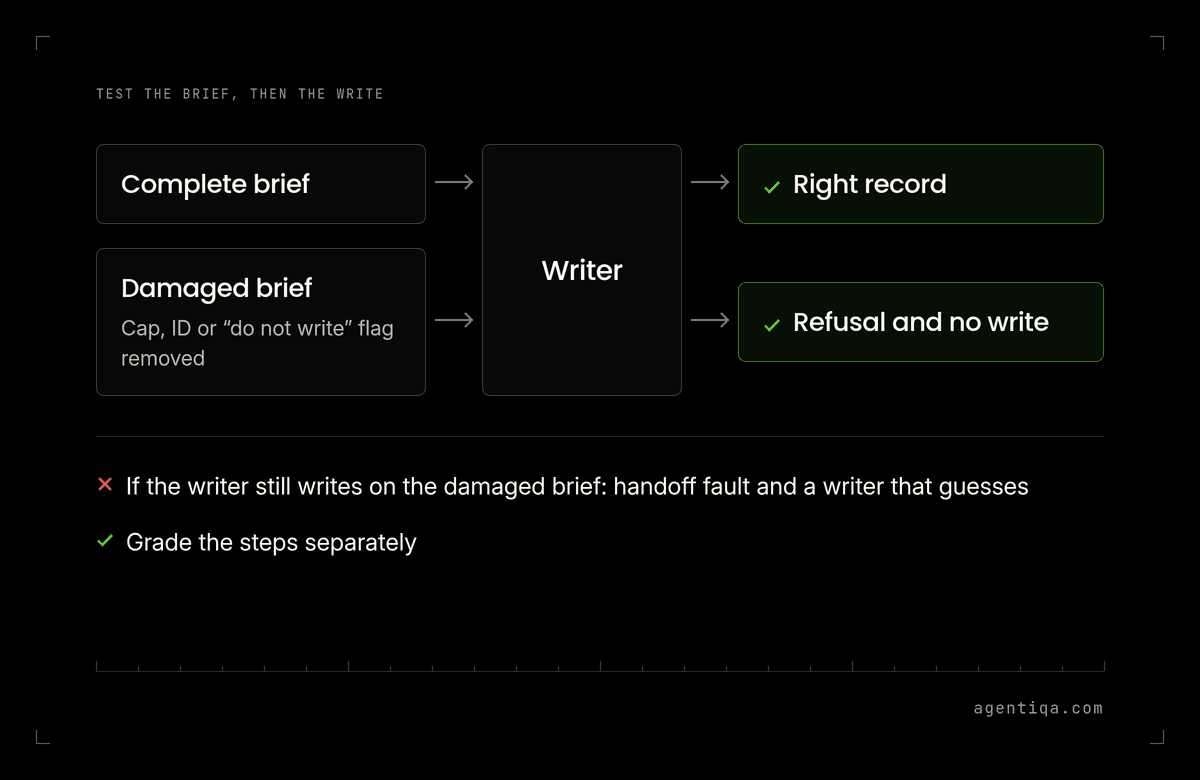
- A complete brief vs. the same brief with the cap, the ID or the "do not write" flag removed.
- A brief that names the intended record vs. one that names a lookalike.
- A brief that stops at B vs. a brief that is summarized by a third agent first.
If the writer is correct, the complete brief produces the right record, and the damaged brief produces a refusal and no write. If the writer still writes on the damaged brief, you have both a handoff fault and a writer that guesses. Fix both, but grade them separately so you know which step failed.
A trace-level coordination score can tell you the handoff happened and that the messages look complete. It cannot tell you that the cancelled-invoice flag survived, or that only one refund row exists. Keep the score if you already use it; add the record check either way.
How Agentiqa fits
Agentiqa is an AI Quality System for production AI agents. With Agentiqa, you describe each task in plain words. When you rerun the failed tasks, AI Quality Manager reports a step as a regression only if it fails again. Unconfirmed failures are listed separately.
First release gates are live within 7 minutes; for enterprise teams, an Agentiqa engineer sets up the gates on the riskiest tasks over a 3-day rollout.
FAQ
How do you test multi-agent handoffs before a write?
Save the brief the writer received, check that the constraints are still in it, then read the system after the run. Pass only if the intended record changed, nothing else did, and the final reply matches those records. Include a case where the brief is missing a constraint and the writer must refuse.
If the final record is correct, did the handoff pass?
Not on its own. A correct record can still come from a brief that dropped a rule the next request will need, or from two agents writing and one of the writes being overwritten. Inspect the brief and count the writes.
Can a coordination metric replace these cases?
No. UAEF, as described in the 11 November 2026 AWS post, can score agent-to-agent handoffs as part of a canonical trace, including a multi-agent coordination dimension. That scores the messages. The saved record still needs a read.
Who is responsible if the brief is wrong and the writer follows it?
For the test, treat it as a failed task, then tag the step: handoff, writer, or both. For the product, decide which agent may write, and which agent may report "done," so those tags have an owner.
Should the first handoff tests run in production?
No. Use a test copy and test data you reset. A bad brief that reaches a writer in production is a real write.
Sources
- Samaneh Aminikhanghahi, Amulya Cherian, Meghana Ashok, Vidya Sagar Ravipati, Tristan Sylvain, Elaine Wu and Yuxuan Zhou, "UAEF: A framework-agnostic system for closed-loop evaluation of AI agents", AWS Machine Learning Blog, 11 November 2026. AWS post. Adapters include agent-to-agent handoffs in the canonical trace; one of 7 scoring dimensions is multi-agent coordination.
Next step
For each task that ends in a write, write down which agent is allowed to write, what the brief must contain, and the record-level pass rule. If you build or run vertical agents and want to turn those handoffs into release gates, we can go through the riskiest tasks with you in 20 minutes.