
In short: AI agent evaluation tools score a run from the agent's trace and reply: what it said, which tools it called, and how the steps look against a rubric or a reference. They do not, on their own, confirm what was saved in a CRM, ERP or billing system. For agents that write data, keep the eval and add a check that reads the record back.
Evaluation tools score an agent on a dataset: a scorer, then a score you can compare between runs. The gap shows up when the agent can write. A high score on the trace can sit next to a missing refund, a second invoice, or a field the task did not ask to change. This guide separates what those tools measure from the write checks you still need, and how to use both.
What are AI agent evaluation tools?
They run an agent on a fixed set of cases and score each run. The score might be an exact match against a reference reply, a rubric judged by another model, or a comparison of the tool calls the agent made with the calls you expected.
A current example is the Universal Agent Evaluation Framework (UAEF), which AWS published on 11 November 2026 and released as open source under the Apache 2.0 license. The AWS post describes UAEF as a framework-agnostic system: an adapter turns the agent's native run — messages, tool calls and agent-to-agent handoffs — into one canonical trace, then scores that trace with 36 built-in metrics across 7 dimensions (tool calling, response quality, responsible AI, performance, multi-turn conversation, multi-agent coordination and reasoning). Ground-truth answers are optional. To score tool calling, the post says the ground truth has to list the expected tool calls, their order and their arguments. Results are stored so a team can compare a new agent version with a baseline.
That is a complete description of a trace-and-response eval. It is also the limit: the object being scored is the trace.
What does a passing eval actually measure?
It measures the parts of the run that appear in the transcript and the tool log:
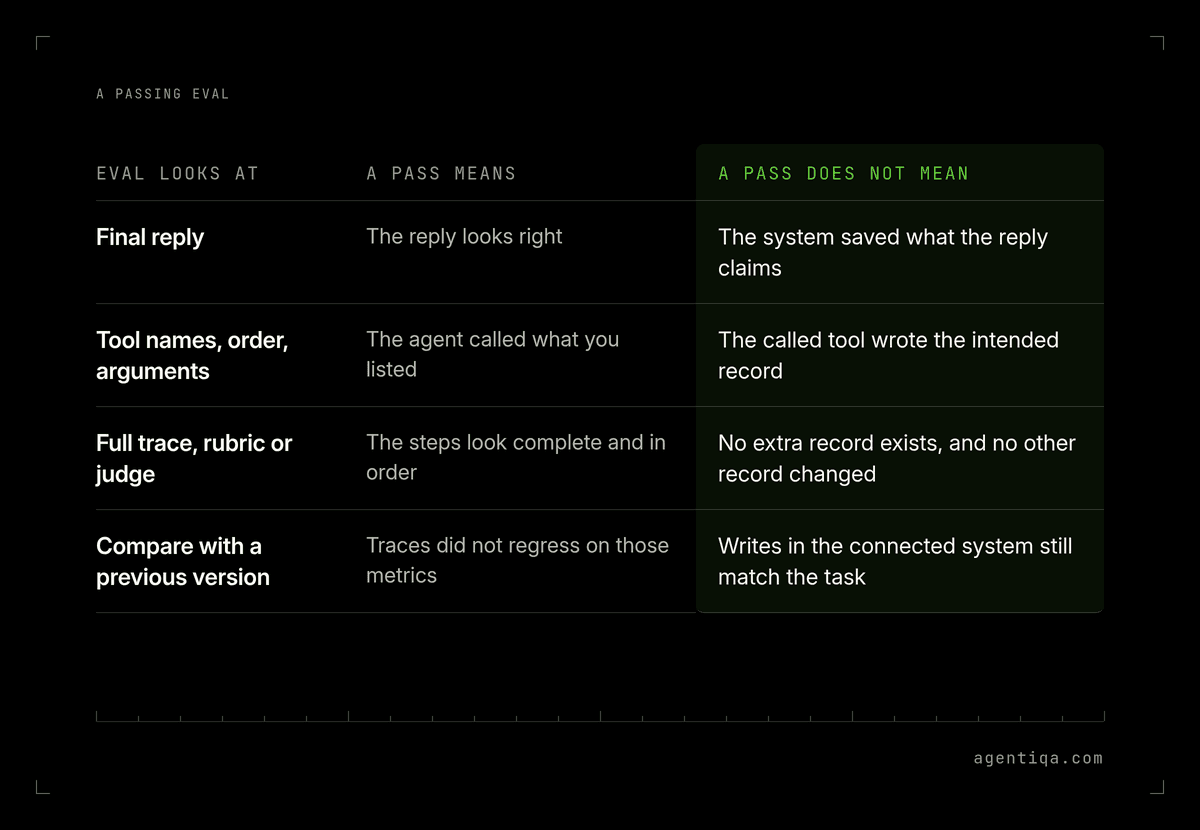
| If the eval looks at | A pass means | A pass does not mean |
|---|---|---|
| The final reply vs. a reference or a rubric | The reply looks right | The system saved what the reply claims |
| Expected tool names, order and arguments | The agent called what you listed | The called tool wrote the intended record |
| A full trace scored by a rubric or a judge | The steps look complete and in order | No extra record exists, and no other record changed |
| A comparison with a previous version's traces | This version's traces did not regress on those metrics | Writes in the connected system still match the task |
In LangChain's State of Agent Engineering survey (1,340 responses, 18 November to 2 December 2025), 52.4% of respondents ran offline evaluations on test sets, and 89% had some observability for their agents. An offline eval on a test set is a good way to score replies and traces before you ship a change. It is not a read of the system the agent writes to.
What do evaluation tools miss when the agent writes data?
Three failure types sit outside the trace, and each already has a longer write-up:
- Hallucinated success. The tool response looks like an "accepted" or "done". The record was not created, or it was created with the wrong values. The trace the eval scores is the same text the agent saw.
- Duplicate writes. A timeout or a retry produced a second refund, invoice or update. The reply still describes a single action.
- A change outside the task. A customer note, a status flag or a second row changed, and the agent did not mention it. A scorer that only reads the trace cannot see records the agent did not talk about.
Worked example (illustrative): a billing agent is asked to issue a 40.00 refund on order 8311. The eval has a reference tool call, create_refund(order=8311, amount=40.00), and the trace matches it. A later read of the test system shows two refund rows for that order, or one refund and a changed payment term the task did not mention. The eval passed. The write did not.
How should you split evals and write checks?
Keep the eval for what it can see. Add a separate check for the saved state:
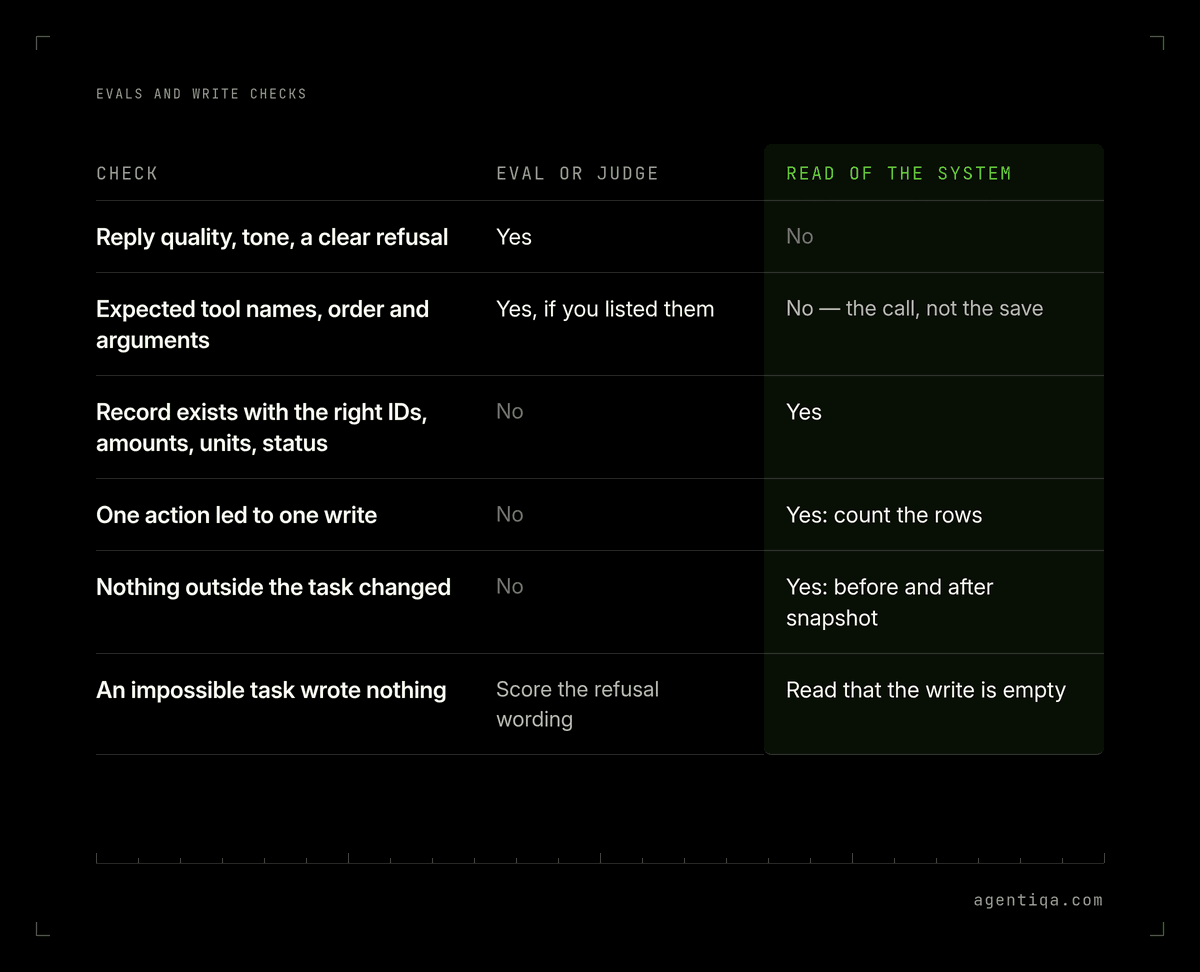
| Check | Use an eval or a judge | Use a read of the system |
|---|---|---|
| Reply quality, tone, a clear refusal | Yes | No |
| Expected tool names, order and arguments | Yes, if you listed them | No — this is still only the call, not the save |
| The record exists with the right IDs, amounts, units and status | No | Yes |
| One action led to one write, including after a retry | No | Yes: count the rows |
| Nothing outside the task changed | No | Yes: compare a before and after snapshot |
| An impossible task wrote nothing | The wording of the refusal can be scored | The empty write needs a read |
How to turn those write checks into concrete cases is in AI agent test cases and in how to test AI agent tool calls. The wider split between tracing, evals and release gates is in AI agent release gates vs observability. A 2026 comparison of testing tools, including Agentiqa, is in AI agent testing tools. When the eval uses a judge, LLM-as-a-judge for AI agents covers what a judge can and cannot grade.
How do you use both on the same task?
- Write the pass rule as a record, not as a score. "One refund row, amount 40.00, status issued, order 8311, no other change on that order or customer."
- Keep an eval for the parts with no single right record: the wording of the email, the explanation in a refusal.
- Run both on a test copy of the system, with fixed test data you reset before every run, so the before/after diff starts from a known state. A test environment write-up covers sandbox, seed data and reset.
- Treat a trace regression and a write failure as different results. A worse rubric score and a duplicate row are not the same kind of fault, and they should not be merged into one number.
How Agentiqa fits
Agentiqa is an AI Quality System for production AI agents. With Agentiqa, you describe each task in plain words. When you rerun the failed tasks, AI Quality Manager reports a step as a regression only if it fails again. Unconfirmed failures are listed separately.
First release gates are live within 7 minutes.
For enterprise teams, an Agentiqa engineer sets up the gates on the riskiest tasks over a 3-day rollout.
FAQ
Are AI agent evaluation tools enough to ship an agent that writes data?
No. They score the trace and the reply. Shipping a write-capable agent also needs a check that the intended record was saved, that it was saved once, and that nothing else changed.
What is the difference between an AI agent eval and a test?
An eval scores a run against a rubric, a reference reply or expected tool calls. A test for a write task has a pass rule in the system itself: the record, the values and the surrounding snapshot. You can run both on the same case.
Do I still need evals if I already read the system back?
Yes, for the parts a record cannot settle: tone, a clear explanation, whether a refusal is usable. The record check does not replace that.
Does a framework that scores 36 metrics close the write gap?
UAEF, as described in the 11 November 2026 AWS post, scores a canonical trace on 36 metrics across 7 dimensions. That is a broad view of the run as the agent recorded it. Confirming what a connected CRM, ERP or billing system saved is a separate read.
Should the eval and the write check run in production?
No. Run them on a test copy with fixed data you reset, so every score and every diff starts from the same state.
Sources
- Samaneh Aminikhanghahi, Amulya Cherian, Meghana Ashok, Vidya Sagar Ravipati, Tristan Sylvain, Elaine Wu and Yuxuan Zhou, "UAEF: A framework-agnostic system for closed-loop evaluation of AI agents", AWS Machine Learning Blog, 11 November 2026. AWS post. Open source under Apache 2.0 (GitHub). UAEF converts a run's messages, tool calls and handoffs into a canonical trace and scores it with 36 built-in metrics across 7 dimensions; ground truth for tool calling must include expected tool calls, order and arguments.
- LangChain, State of Agent Engineering. Survey run 18 November to 2 December 2025, 1,340 responses: 89% of respondents had some observability for their agents; 52.4% ran offline evaluations on test sets.
Testing your own agent? Start free with the Agentiqa Community Edition: 20 runs a month, no credit card. Plans are on the pricing page.